

Timing Types
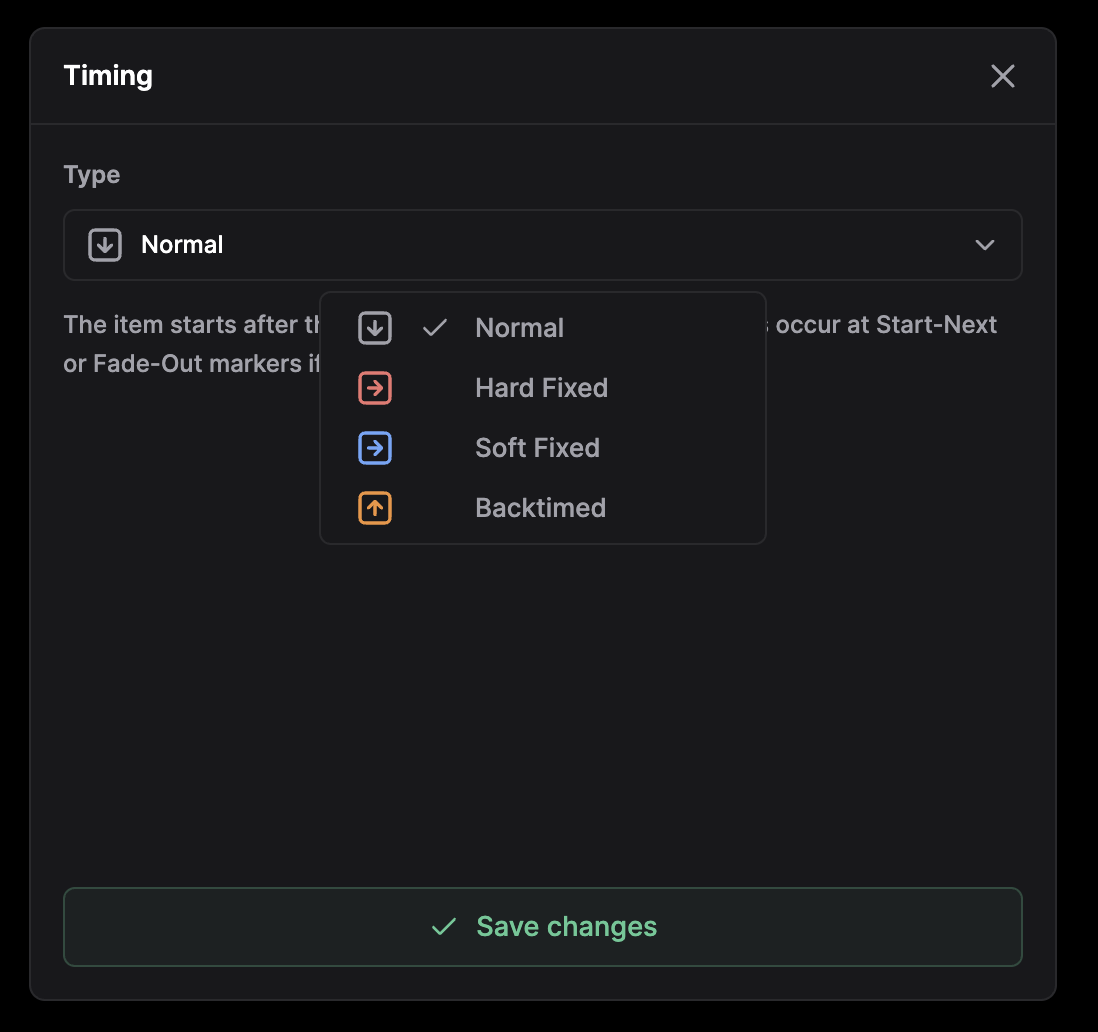
Timing types control when items start in a sequence. Each item has a timing type that determines its relationship to surrounding items and the hour boundaries.
Overview
| Type | Behavior | Interrupts Previous |
|---|---|---|
| Normal | Starts after previous item ends | No |
| Hard Fixed | Starts at exact time | Yes |
| Soft Fixed | Starts at target time, waits for previous | Conditional |
| Backtimed | Ends exactly when next fixed item starts | No |
Hour Boundaries
Each sequence contains two boundary markers:
- Hour Start: Defines how the hour begins
- Hour End: Defines how the hour ends
These markers use timing types to control transitions between hours. For example, setting Hour End to Hard Fixed ensures the next hour starts exactly on time. Setting it to Soft Fixed allows the current song to finish before transitioning.
Normal
The default timing type. Items start when the previous item completes.
Behavior:
- Waits for the previous item to finish
- Respects cue points (Start-Next or Fade-Out markers) on the previous item
- No time guarantee
Example:
| Time | Item | Duration |
|---|---|---|
| 00:00 | Song A | 3:30 |
| 03:30 | Song B (Normal) | 4:00 |
| 07:30 | Song C (Normal) | 3:15 |
Each song starts immediately after the previous one ends.
Hard Fixed
Items start at an exact time, interrupting any currently playing content.
Behavior:
- Starts precisely at the configured time
- Cuts off the previous item immediately if still playing
- Guarantees the scheduled start time
Use cases:
- News at the top of the hour
- Scheduled ad breaks
- Time-critical announcements
Configuration:
| Parameter | Description |
|---|---|
| Fixed Time | Start time within the hour (MM:SS) |
Example:
| Time | Item | Note |
|---|---|---|
| 11:57:00 | Song (4:00) | Would normally end at 12:01:00 |
| 12:00:00 | News (Hard Fixed) | Song interrupted at 12:00:00 |
The song plays for 3 minutes instead of 4. At exactly 12:00:00, the news starts regardless of the song's remaining duration.
Soft Fixed
Items target a specific time but wait for the previous item to complete. A time window limits how late the item can start.
Behavior:
- Aims to start at the configured time
- Waits for the previous item to finish
- If the time window expires, the previous item is interrupted
Configuration:
| Parameter | Description |
|---|---|
| Fixed Time | Target start time (MM:SS) |
| Time Window | Maximum allowed delay beyond the fixed time |
Without Time Window
The item waits indefinitely for the previous item to finish.
| Time | Item | Note |
|---|---|---|
| 11:58:00 | Song (5:00) | Ends at 12:03:00 |
| 12:00:00 | News (Soft Fixed, no window) | Waits for song |
| 12:03:00 | News starts | 3 minutes late |
With Time Window
The time window defines the maximum delay. When the window expires, the previous item is interrupted.
Example:
| Planned | Item | Configuration |
|---|---|---|
| 11:58:45 | Song (4:00) | Would end at 12:02:45 |
| 12:00:00 | News | Soft Fixed, 60s window |
Result:
| Time | Event |
|---|---|
| 11:58:45 | Song starts |
| 12:00:00 | News target time reached, song still playing |
| 12:01:00 | Window expires, song interrupted |
| 12:01:00 | News starts |
The song plays for 2:15 instead of 4:00. The news starts at 12:01:00 (maximum 60 seconds late) rather than waiting until 12:02:45.
Backtimed
Items are calculated backwards to end exactly when the next fixed-time item starts.
Behavior:
- Start time calculated from the next Hard Fixed or Soft Fixed item
- Duration adjusts to fill the available time exactly
- Multiple consecutive backtimed items form a chain
Use cases:
- Jingles before news
- Music that must end at a specific time
- Filling gaps before fixed content
Single Backtimed Item
Example:
| Item | Configuration | Duration |
|---|---|---|
| Jingle | Backtimed | 0:15 |
| News | Hard Fixed at 00:00 | 5:00 |
The jingle starts at 59:45 and ends exactly at 00:00 when the news begins.
Backtimed Chain
When multiple backtimed items appear in sequence, they form a chain. The system calculates start times backwards from the next fixed item.
Example:
| Item | Original Duration | Configuration |
|---|---|---|
| Song A | 3:00 | Backtimed |
| Song B | 4:00 | Backtimed |
| News | 5:00 | Hard Fixed at 12:00:00 |
Calculation:
- News starts at 12:00:00
- Song B must end at 12:00:00, starts at 11:56:00
- Song A must end at 11:56:00, starts at 11:53:00
| Time | Item |
|---|---|
| 11:53:00 | Song A starts |
| 11:56:00 | Song A ends, Song B starts |
| 12:00:00 | Song B ends, News starts |
Both songs play in full because there is enough time. If previous content runs long, backtimed items may be shortened proportionally.
Complete Hour Example
This example shows a typical hour with mixed timing types.
Sequence configuration:
| Position | Item | Timing | Fixed Time |
|---|---|---|---|
| 1 | Hour Start | Hard Fixed | 00:00 |
| 2 | Music Block | Normal | - |
| 3 | News | Hard Fixed | 30:00 |
| 4 | Music Block | Normal | - |
| 5 | Hour End | Soft Fixed | 00:00 |
Resulting playback:
| Time | Event |
|---|---|
| 00:00:00 | Hour starts, music begins |
| 00:00:00–00:28:00 | Songs play sequentially (Normal timing) |
| 00:28:00 | Song starts, would end at 00:32:00 |
| 00:30:00 | News starts (Hard Fixed), song interrupted |
| 00:35:00 | News ends, music resumes |
| 00:35:00–00:59:00 | Songs play sequentially |
| 00:59:00 | Final song starts |
| 01:00:00+ | Hour End (Soft Fixed) waits for song to finish |
| 01:02:30 | Song ends, next hour begins |
The Hard Fixed news interrupts music at exactly 30:00. The Soft Fixed hour end allows the final song to complete before transitioning.
Timing Indicators
The system displays timing conflicts in the rotation view:
| Indicator | Meaning |
|---|---|
| Will be interrupted | A Hard Fixed item will cut off this item |
| Will be skipped | Timing rules make this item impossible to play |
| Overplanned | Item extends past the hour boundary |
Setting Timing Types
In the Sequence Editor
- Open Station > Sequences
- Select a sequence
- Click the timing icon on an entry
- Select the timing type
- Configure Fixed Time and Time Window if applicable
- Save the sequence
In the Rotation View
- Open the rotation
- Click the timing icon on an item
- Select the new timing type
- Enter parameters as needed
Changes to rotation items affect only that rotation instance.
Related Topics
- Sequences - Create templates with timing rules
- Rotations - View calculated start times
- Week Planner - Assign sequences to time blocks